
Opening The Calendar My Father Kept on the Fridge
For most of my childhood, our fridge had two calendars stuck to it with magnets one from the local bank with Gregorian months, and one handwritten by my father listing every Wiladat and Shahadat of the Masumeen in Hijri dates. Every few weeks he’d flip both calendars, cross-check them against each other, and announce at dinner, “Next Thursday is Bibi Fatima’s Wiladat” or “Imam Ridha’s Shahadat is coming up, we should read Ziyarat.” That habit of holding both calendars side by side is exactly what this article tries to do for you, so you don’t need two separate pieces of paper on your fridge to know when to celebrate and when to mourn.
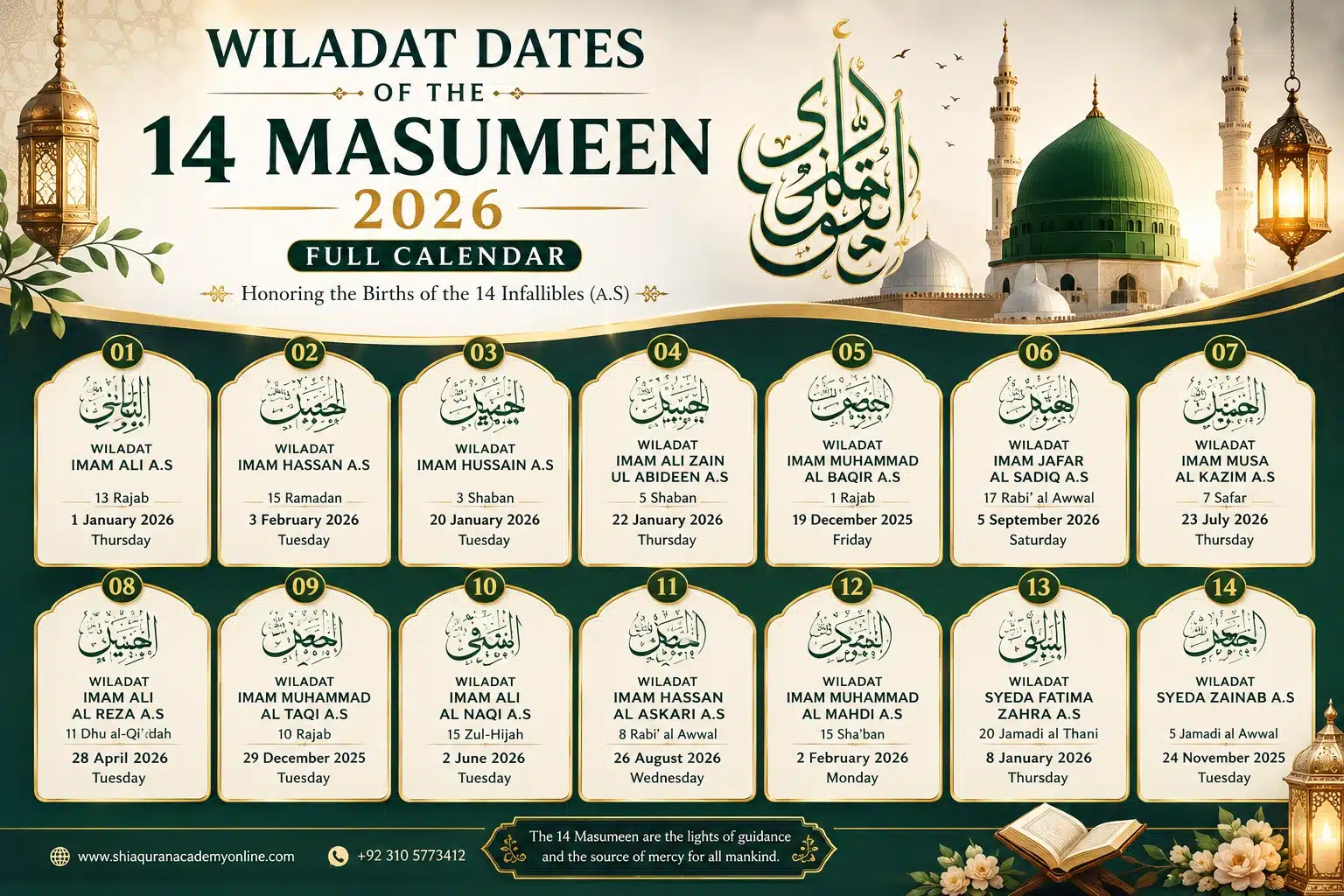
Below, you’ll find the 2026 Wiladat calendar for all fourteen Masumeen — the Prophet Muhammad (s.a.w.), Sayyida Fatima al-Zahra (s.a.), and the Twelve Imams (a.s.) with both the Hijri date and its corresponding English/Gregorian date, along with where each of them was born, how their earthly life ended, and where they are laid to rest.
Who Are the Masumeen, and Why Do We Believe They Were Divinely Appointed?
The word Ma’sūm (معصوم) means “infallible” one protected by Allah from sin and error. In Shia belief, this status belongs to fourteen individuals: Prophet Muhammad (s.a.w.), his daughter Fatima al-Zahra (s.a.), and the twelve Imams descended from her and Imam Ali (a.s.), ending with Imam Muhammad al-Mahdi (a.f.), who remains alive in occultation. This isn’t a title the community invented after the fact — it is something the Qur’an itself describes, and something the Prophet repeatedly emphasized in his own lifetime.
The clearest Qur’anic evidence is the Verse of Purification, revealed regarding the Prophet, Ali, Fatima, Hasan, and Hussain (a.s.) the Ahlul Bayt gathered together under a cloak:
Arabic: إِنَّمَا يُرِيدُ اللَّهُ لِيُذْهِبَ عَنكُمُ الرِّجْسَ أَهْلَ الْبَيْتِ وَيُطَهِّرَكُمْ تَطْهِيرًا
Transliteration: Innamā yurīdu-llāhu li-yudh’hiba ‘ankumu-r-rijsa ahla-l-bayti wa yuṭahhirakum taṭhīrā.
Translation: “Allah only intends to remove impurity from you, O People of the House, and to purify you with a thorough purification.” (Surah al-Ahzab 33:33)
A second verse, known as Ayat al-Wilayah (the Verse of Guardianship), is understood by Shia scholars to have been revealed regarding Imam Ali (a.s.), referring to an incident where he gave his ring in charity while bowing in prayer:
Arabic: إِنَّمَا وَلِيُّكُمُ اللَّهُ وَرَسُولُهُ وَالَّذِينَ آمَنُوا الَّذِينَ يُقِيمُونَ الصَّلَاةَ وَيُؤْتُونَ الزَّكَاةَ وَهُمْ رَاكِعُونَ
Transliteration: Innamā waliyyukumu-llāhu wa rasūluhu wa-lladhīna āmanū-lladhīna yuqīmūna-ṣ-ṣalāta wa yu’tūna-z-zakāta wa hum rāki’ūn.
Translation: “Your guardian is only Allah, His Messenger, and those who believe — those who establish prayer and give charity while bowing.” (Surah al-Ma’idah 5:55)
Alongside these verses, the Prophet’s own words affirm this line of leadership. In the widely narrated Hadith al-Thaqalayn — recorded even in Sahih Muslim, not only Shia sources — the Prophet said:
Arabic: إِنِّي تَارِكٌ فِيكُمُ الثَّقَلَيْنِ: كِتَابَ اللَّهِ وَعِتْرَتِي أَهْلَ بَيْتِي، مَا إِنْ تَمَسَّكْتُمْ بِهِمَا لَنْ تَضِلُّوا بَعْدِي أَبَدًا
Transliteration: Innī tārikun fīkumu-th-thaqalayn: kitāba-llāhi wa ‘itratī ahla baytī, mā in tamassaktum bihimā lan taḍillū ba’dī abadā.
Translation: “I am leaving behind among you two weighty things: the Book of Allah and my progeny, the People of my House. As long as you hold on to both of them, you will never go astray after me.”
Taken together — the Qur’an’s own description of the Ahlul Bayt’s purification, the incident behind Ayat al-Wilayah, and the Prophet’s explicit instruction to hold onto his family alongside the Qur’an — these form the core scriptural basis for why Shia Muslims regard the fourteen Masumeen as divinely chosen guides, not simply respected historical scholars.
The 2026 Wiladat Calendar (Hijri & Gregorian)
A note before you read further: Hijri-to-Gregorian conversions are astronomical estimates and can shift by a day depending on regional moon-sighting. Please confirm exact dates with your local marja’ or Imambargah closer to each occasion.
1. Prophet Muhammad (s.a.w.)
- Wiladat: 17 Rabi’ al-Awwal 1448 AH → Sunday, August 30, 2026
- Birthplace: Mecca, in the Year of the Elephant (570 CE)
- Passing: 28 Safar 11 AH, in Medina. Shia sources hold that he was poisoned years earlier by a Jewish woman of Khaybar, with the effects of that poison contributing to his final illness.
- Resting place: Masjid an-Nabawi, Medina, Saudi Arabia
2. Sayyida Fatima al-Zahra (s.a.)
- Wiladat: 20 Jumada al-Thani 1448 AH → Monday, November 30, 2026
- Birthplace: Mecca
- Passing: Martyred within months of her father’s passing, in 11 AH. Shia narrations describe her being struck and injured at her own doorway during a confrontation involving Umar ibn al-Khattab and Qunfudh, sent to compel Imam Ali’s allegiance, resulting in a miscarriage and injuries from which she never recovered.
- Resting place: Jannat al-Baqi, Medina — her exact grave was deliberately kept unmarked at her own request, and remains unknown to this day.
3. Imam Ali ibn Abi Talib (a.s.)
- Wiladat: 13 Rajab 1447 AH → Thursday, January 1, 2026 (Rajab recurs later in the year too — 13 Rajab 1448 AH falls around Tuesday, December 22, 2026)
- Birthplace: Inside the Ka’aba, Mecca
- Passing: Martyred 21 Ramadan 40 AH, after being struck with a poisoned sword by Abd al-Rahman ibn Muljim, a Kharijite, while prostrating in prayer at the mosque of Kufa on the 19th of Ramadan.
- Resting place: Imam Ali Shrine, Najaf, Iraq
4. Imam Hasan ibn Ali (a.s.)
- Wiladat: 15 Ramadan 1447 AH → Wednesday, March 4, 2026
- Birthplace: Medina
- Passing: Martyred 28 Safar 50 AH, poisoned by his wife Ja’da bint al-Ash’ath, who Shia sources say was incited and bribed by Mu’awiya ibn Abi Sufyan.
- Resting place: Jannat al-Baqi, Medina
5. Imam Hussain ibn Ali (a.s.)
- Wiladat: 3 Sha’ban 1447 AH → Wednesday, January 21, 2026
- Birthplace: Medina
- Passing: Martyred 10 Muharram 61 AH at Karbala, killed in battle against the army of Yazid ibn Mu’awiya, commanded on the field by Umar ibn Sa’d, with the fatal blow reportedly struck by Shimr ibn Dhi’l-Jawshan.
- Resting place: Imam Hussain Shrine, Karbala, Iraq
6. Imam Ali ibn al-Hussain, Zain al-Abideen (a.s.)
- Wiladat: 5 Sha’ban 1447 AH → Friday, January 23, 2026
- Birthplace: Medina
- Passing: Martyred 25 Muharram 95 AH, poisoned on the order of the Umayyad Caliph al-Walid ibn Abd al-Malik.
- Resting place: Jannat al-Baqi, Medina
7. Imam Muhammad al-Baqir (a.s.)
- Wiladat: 1 Rajab 1448 AH → Thursday, December 10, 2026
- Birthplace: Medina
- Passing: Martyred 7 Dhul Hijjah 114 AH, poisoned on the order of the Umayyad Caliph Hisham ibn Abd al-Malik.
- Resting place: Jannat al-Baqi, Medina
8. Imam Ja’far al-Sadiq (a.s.)
- Wiladat: 17 Rabi’ al-Awwal 1448 AH → Sunday, August 30, 2026 (same day as the Prophet’s Wiladat, widely celebrated together)
- Birthplace: Medina
- Passing: Martyred 25 Shawwal 148 AH, poisoned on the order of the Abbasid Caliph al-Mansur.
- Resting place: Jannat al-Baqi, Medina
9. Imam Musa al-Kadhim (a.s.)
- Wiladat: 7 Safar 1448 AH → Wednesday, July 22, 2026
- Birthplace: Al-Abwa, near Medina
- Passing: Martyred 25 Rajab 183 AH, poisoned while imprisoned in Baghdad on the order of the Abbasid Caliph Harun al-Rashid.
- Resting place: Kadhimiya Shrine, Baghdad, Iraq
10. Imam Ali al-Ridha (a.s.)
- Wiladat: 11 Dhul Qa’dah 1447 AH → Tuesday, April 28, 2026
- Birthplace: Medina
- Passing: Martyred in Safar 203 AH, poisoned with grapes on the order of the Abbasid Caliph al-Ma’mun, after being forced into the position of crown prince.
- Resting place: Imam Reza Shrine, Mashhad, Iran
11. Imam Muhammad al-Jawad, at-Taqi (a.s.)
- Wiladat: 10 Rajab 1448 AH → Saturday, December 19, 2026
- Birthplace: Medina
- Passing: Martyred Dhul Qa’dah 220 AH, poisoned by his own wife Umm al-Fadl, reportedly instigated by the Abbasid Caliph al-Mu’tasim.
- Resting place: Kadhimiya Shrine, Baghdad, Iraq
12. Imam Ali al-Hadi, an-Naqi (a.s.)
- Wiladat: 2 Rajab 1448 AH → Friday, December 11, 2026
- Birthplace: Surayya, near Medina
- Passing: Martyred 3 Rajab 254 AH, poisoned on the order of the Abbasid Caliph al-Mu’tazz.
- Resting place: Al-Askari Shrine, Samarra, Iraq
13. Imam Hasan al-Askari (a.s.)
- Wiladat: 8 Rabi’ al-Thani 1448 AH → Sunday, September 20, 2026
- Birthplace: Medina
- Passing: Martyred 8 Rabi’ al-Awwal 260 AH, poisoned on the order of the Abbasid Caliph al-Mu’tamid.
- Resting place: Al-Askari Shrine, Samarra, Iraq
14. Imam Muhammad al-Mahdi (a.f.)
- Wiladat: 15 Sha’ban 1447 AH → Monday night into Tuesday, February 2–3, 2026
- Birthplace: Samarra, Iraq
- Status: Living in occultation since 260 AH by Allah’s command; his reappearance will mark the establishment of global justice, as foretold in numerous hadith from the Prophet (s.a.w.).
- Associated place: Samarra, Iraq (site of his occultation)
A Pattern Worth Pausing On
Reading through this list, one thing becomes hard to ignore: eleven of the fourteen Masumeen were killed through poison or a targeted attack, almost always at the direct order of the ruling caliph of their time — Umayyad or Abbasid. This wasn’t scattered persecution; it was a consistent, generational effort by successive political powers to eliminate a line of leadership they saw as a threat to their own authority. Explaining this pattern to children and new learners often does more to convey the meaning of “Imamate” than any single date can — these were not natural deaths of scholars who happened to pass away, but a sustained history of martyrdom for a cause.
Bringing This Calendar Into Daily Practice
Knowing these dates matters most when they’re actually used — reciting a short dua on a Wiladat, visiting or reading the Ziyarat of an Imam on their Shahadat, or simply telling your children one story from that Imam’s life on the day itself. If you’d like structured help learning the correct Ziyarat, Salawat, and duas connected to each of these dates, our Ziyarat & Duas course walks students through them one Imam at a time, and our Islamic history course covers the full seerah of each Masum in age-appropriate depth.
Frequently Asked Questions
Why do some Wiladat dates fall twice in the 2026 Gregorian calendar? Because the Islamic lunar year is about 10–11 days shorter than the solar year, some Hijri months shift enough to occur twice within a single Gregorian year — this is why 13 Rajab (Imam Ali’s Wiladat) falls both in early January and late December 2026.
Are these Gregorian dates 100% fixed? No — they are based on astronomical calculation and may shift by a day depending on your region’s moon-sighting confirmation. Always check with your local Imambargah or marja’ closer to the date.
Why were so many of the Imams poisoned rather than killed openly? Poisoning allowed ruling caliphs to eliminate a rival source of religious authority while publicly denying responsibility, avoiding the backlash that an open execution — like Imam Hussain’s — had caused for the Umayyads.
Is Imam al-Mahdi’s Wiladat celebrated differently from the others? Yes — since he is believed to be alive in occultation rather than deceased, his Wiladat is celebrated with particular joy and hope, rather than the reflective tone of a historical anniversary.
Where can I find a printable version of this calendar? We’re working on a downloadable version — for now, bookmark this page, as we’ll update it with a printable PDF as soon as it’s ready.
Read More From Our Islamic Calendar Collection
- Shab-e-Barat 2026: Date, Significance & Shia Aamal Guide
- What Is Arbaeen and Why Do Millions Walk to Karbala?
- Muharram and Ashura: A Complete Guide for Shia Families
- Who Was Imam Hussain (a.s.)? A Complete Guide for Families
(Internal links to be added once these companion posts are published — see linking notes below.)
Tags: wiladat dates 2026, 14 masumeen calendar, imam birthday dates 2026, shia islamic calendar 2026, imam ali wiladat date, imam hussain birthday, imam mahdi wiladat, hijri to english calendar 2026, ahlulbayt birth dates, shia imams martyrdom history, karbala imam history, shia islamic education calendar
Free Trial CTA: Want your family to learn the life, Ziyarat, and duas of each Masum in proper sequence throughout the year? Start a free trial with Shia Quran Academy Online on WhatsApp →